
Most people notice the first fine line long before the first wrinkle, and the two are not the same concern. Fine lines are shallow surface creases that appear early, often around the eyes and mouth. Wrinkles are deeper folds that form once the skin’s collagen and elastin supply has thinned. Knowing which one is present helps a person understand which anti-ageing treatments options exist and which of them match the concern, instead of using a wrinkle treatment for what is really a hydration or sun damage issue.
This guide explains how each anti-ageing treatments for wrinkles and anti-ageing treatments for fine lines works, what published research says about it and which risks and limits apply. It is general health education, not a recommendation to undergo any procedure, and many fine lines can be managed with sun protection and basic skincare alone.
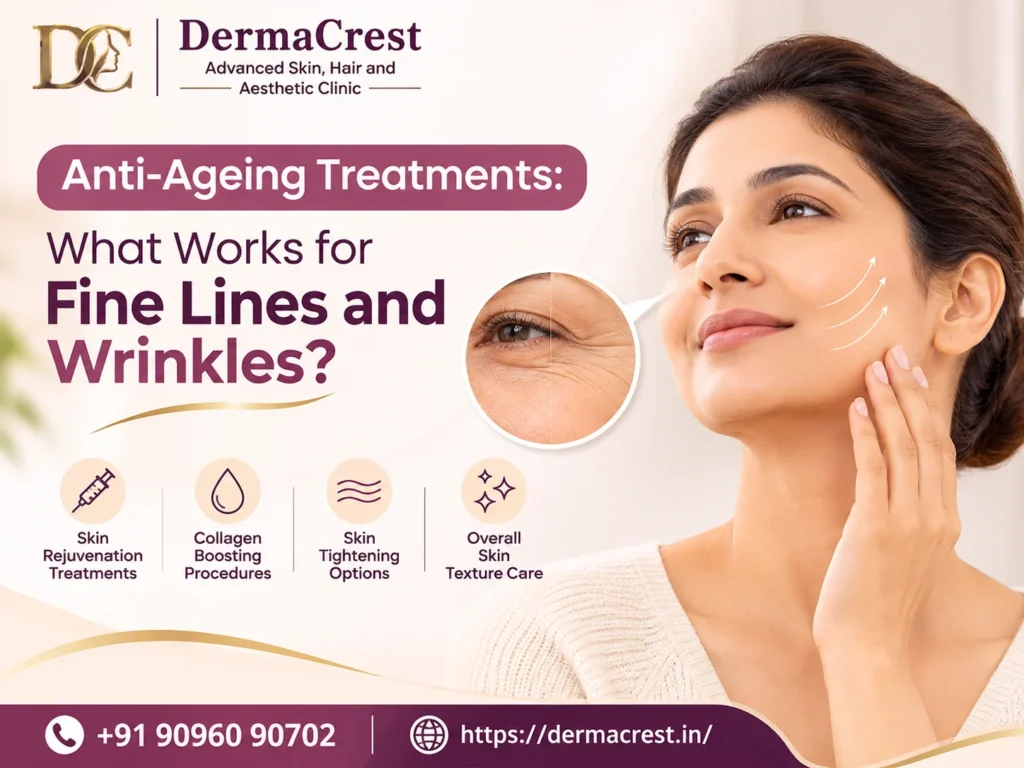
What Is the Difference Between Fine Lines and Wrinkles?
Fine lines are shallow, surface-level creases that usually appear first around the eyes, forehead and mouth, linked to dehydration, sun exposure and early collagen loss. Wrinkles are deeper, more permanent folds that develop once repeated muscle movement combines with a long-term loss of collagen and elastin in the dermis. A fine lines treatment generally works on the skin’s surface and hydration levels, while a wrinkle treatment usually acts deeper, on muscle activity or collagen structure.
What Causes Skin to Age and Develop Wrinkles?
Skin ageing is driven by a mix of biological and lifestyle factors that work together over time.
• Collagen and elastin decline: According to dermatology sources, skin loses roughly one percent of its collagen every year after the age of twenty, which makes the skin thinner and less able to spring back into place.
• Sun exposure: Ultraviolet rays break down collagen fibres faster than the body can replace them, a process commonly called photoageing.
• Repeated facial movement: Expressions such as frowning, squinting and smiling gradually press lines into the skin, which is how forehead wrinkles and crow’s feet typically form.
• Hormonal changes: Oestrogen supports collagen production, so a drop in oestrogen after menopause can speed up collagen loss.
• Lifestyle factors: Smoking, high sugar intake and poor sleep are linked to faster collagen breakdown and slower skin repair.
What Are the Main Types of Anti-Ageing Treatments for Wrinkles?
A facial anti-ageing treatments plan can draw from four broad categories, and a doctor may combine more than one depending on the skin concern.
• Topical treatment for ageing skin: Prescription retinoids and antioxidant products that support collagen production from the surface.
• Injectable treatment: Botulinum toxin and dermal fillers, used to relax muscle movement or restore lost volume.
• Resurfacing treatment: Chemical peels and microneedling, which work by triggering the skin’s own repair response.
• Energy-based treatment: Laser and radiofrequency devices, which heat the deeper skin layers to stimulate new collagen and are used as a facial wrinkle reduction treatment for early signs of ageing.
None of these categories is inherently superior to another, and each carries risks. The right anti-wrinkle skin treatment, if any is needed, depends on whether the lines are caused mainly by muscle movement, volume loss, sun damage or skin laxity. No treatment can guarantee a particular result.
How Does Botox Help With Forehead Wrinkles and Crow’s Feet?
Botox for wrinkles refers to botulinum toxin type A injections, and Botox is one brand name for it. This guide does not endorse any brand or product. As an injectable anti-ageing treatments, the toxin temporarily blocks the nerve signals that tell a muscle to contract, which relaxes the muscle under a line. Doctors use it as a treatment for forehead wrinkles and treatment for crow’s feet, since both form from repeated muscle activity.
Effects typically begin within a few days, reach full strength in about two weeks and last around three to four months, after which muscle activity gradually returns. Botulinum toxin addresses lines caused by movement and has limited effect on static wrinkles that remain visible at rest, which doctors may manage with a resurfacing or energy-based anti-ageing treatments for wrinkles instead. Possible effects include temporary bruising at the injection site and mild headache. Drooping of the eyelid or brow is uncommon but can occur if the toxin spreads to nearby muscles. Results vary from person to person.
What Is Microneedling and How Does It Treat Fine Lines?
Microneedling for fine lines, also called collagen induction therapy, uses a device with very fine needles to create thousands of controlled micro-injuries in the skin. This triggers the body’s wound-healing response, and a clinical study of six sessions found increased type I and type III collagen on skin biopsy. Published evidence for wrinkles is more limited than for scars, so expectations should stay measured.
As a collagen stimulation treatment within anti-ageing care, microneedling is usually done in a series of three to four sessions spaced four to six weeks apart, and changes in fine lines, texture and firmness may continue to develop for several months afterwards. Redness and pinpoint bleeding are expected after a session. It is not suitable for people with active skin infection, clotting disorders, collagen vascular disease or weakened immunity.
How Do Chemical Peels Treat Ageing Skin?
A chemical peel for ageing skin works by removing the outer layer of damaged skin cells, which reveals fresher skin underneath and stimulates new collagen formation. Peels are grouped by depth, and depth determines both the effect and the recovery time.
• Superficial peels: Use alpha-hydroxy or beta-hydroxy acids, are used for mild fine lines and uneven texture, and usually need a few days of visible recovery.
• Medium-depth peels: Use trichloroacetic acid, reach the upper dermis, are used for more noticeable sun damage and wrinkling, and typically need one to two weeks of downtime.
• Deep peels: Use phenol-based solutions, act on deep wrinkles, and need several weeks of recovery along with months of sun protection afterwards.
Possible effects include redness, peeling and pigmentation changes, and darker skin tones carry a higher risk of pigmentation changes with stronger peels, so the doctor chooses depth based on skin type. As an anti-ageing treatments for fine lines caused mainly by sun damage and uneven texture, a superficial or medium peel is the usual range considered.
What Is Laser Treatment for Wrinkles and Skin Rejuvenation?
Laser treatment for wrinkles falls into two broad types, and the difference between them matters more than the brand name of the device.
• Ablative lasers: Devices such as CO2 and erbium lasers remove the surface layer of skin and heat the layer beneath it, which allows greater change in wrinkles and texture at the cost of one to two weeks of downtime.
• Non-ablative lasers: Devices that heat the deeper skin layers without removing the surface, offering a gentler skin rejuvenation laser treatment with a few days of redness, though they usually need a series of sessions.
Fractional versions of both types treat the skin in a grid pattern rather than all at once, which shortens healing time and is used in facial rejuvenation treatment over a course of sessions. Either option is an energy-based anti-ageing treatments, and risks include redness, swelling and pigmentation changes, particularly in deeper skin tones. The choice usually comes down to how much downtime a person can accommodate.
How Does Radiofrequency Skin Tightening Work for Loose, Ageing Skin?
Among non-surgical anti-ageing treatments options, radiofrequency skin tightening uses controlled heat, usually in the range of forty to forty two degrees Celsius, to warm the dermis without damaging the skin’s surface. The heat makes existing collagen fibres contract right away, which produces a mild tightening effect, while new collagen continues forming over the following three to six months.
A review in the Journal of Cosmetic Dermatology reports that radiofrequency appears to reduce visible signs of skin ageing without surgery or significant downtime, although a study in the Journal of the American Academy of Dermatology noted that results may be less pronounced than with ablative treatments. As a skin tightening treatment and collagen boosting skin treatment in anti-ageing care, radiofrequency may be used on its own or alongside microneedling, with temporary redness the most common effect.
Which Non-Surgical Anti-Ageing Treatment Is Right for Your Skin?
No single non-surgical anti-ageing treatments suits every skin concern, so doctors match the option to what is driving the ageing signs. The points below are general information only.
• For fine lines from dehydration or early sun damage: Sun protection, moisturisation and prescribed topical products are the usual first steps, and a superficial chemical peel or a course of microneedling for fine lines may be considered.
• For expression lines such as forehead wrinkles or crow’s feet: Botulinum toxin is the option doctors commonly use, since it acts on the muscle movement directly.
• For deeper, static wrinkles from long-term collagen loss: Laser treatment for wrinkles, a collagen stimulation treatment or a combination of the two may be considered.
• For loose skin with visible laxity: Radiofrequency skin tightening or a medium-depth chemical peel for ageing skin may be considered.
A registered doctor can examine the skin in person, take the medical history into account and advise on a treatment for ageing skin that fits the concern and skin type, including the option of no procedure. What works as an anti-ageing treatment for one person’s forehead wrinkles may not suit another person’s crow’s feet in the same way.
Anti-Ageing Treatment Options in Pune
Anti-ageing treatment in Wakad, Pune is provided by dermatologists and other registered medical practitioners, and the range includes the injectable, resurfacing and energy-based options described above. People looking for wrinkle treatment in Pune or fine lines treatment in Pune, including any anti-ageing option, can check that the doctor holds a recognised qualification and an active registration with the state medical council, and can expect an assessment of skin type, depth of lines and medical history before any plan is suggested.
Skin rejuvenation treatment in Pune is available through registered skin specialists in several parts of the city, including a skin specialist in Wakad, Pune. When comparing an anti-ageing doctor in Pune for facial wrinkle treatment in Pune, the practitioner’s registration, the facilities and the risks explained during consultation are more reliable markers than the treatment name alone.
Where Can Find a Skin Clinic in Wakad for Wrinkle & Fine Line Care?
DermaCrest Advanced Skin, Hair and Aesthetic clinic is a skin clinic in Wakad, Pune, where Dr. Namrata Methe and Dr. Snehal Mahajan see patients with skin, hair and aesthetic concerns, including the early signs of ageing covered in this guide.
Anyone looking for a skin doctor in Wakad for fine lines and wrinkles can use an in-person consultation to have skin type, the depth of the lines and medical history assessed first. That assessment is what lets the doctor decide whether Botox, microneedling, a chemical peel, laser or radiofrequency skin tightening suits the concern, or whether a simple skincare change is enough.
Frequently Asked Questions
At what age should fine lines and wrinkles be treated?
There is no fixed age, and treatment is optional. Fine lines often start appearing in the mid to late twenties, which is why anti-ageing advice usually begins with skincare habits, while deeper wrinkles usually become noticeable from the late thirties onward. Sunscreen and prescribed retinoids are the usual preventive measures, and an in-clinic anti-ageing treatments for wrinkles is a personal choice made after medical assessment.
Is Botox safe for forehead wrinkles and crow’s feet?
Botulinum toxin injections are a recognised medical treatment when given by a trained, registered doctor, but they are not risk-free. Possible effects include bruising, mild headache and, uncommonly, drooping of the eyelid or brow. Results are temporary, usually lasting three to four months, and vary between people.
How long do the results of anti-ageing skin treatments last?
This varies by treatment and by person. Botulinum toxin effects last around three to four months. Microneedling, chemical peel, laser and radiofrequency changes develop over weeks to months as new collagen forms, but natural ageing continues afterwards. No treatment gives a permanent or guaranteed result.
Can microneedling and chemical peels be combined?
These two are not usually done in the same session, since both create a controlled injury to the skin and combining them can increase the risk of irritation. A doctor may space them a few weeks apart as part of a broader skin rejuvenation treatment plan.
What is the difference between ablative and non-ablative laser treatment for wrinkles?
Ablative lasers remove the skin’s surface layer and need more downtime, usually one to two weeks. Non-ablative lasers work beneath the surface with a few days of redness, but usually need more sessions to reach a similar degree of change.
Are non-surgical anti-ageing treatments permanent?
No. Botulinum toxin, microneedling, chemical peels, laser treatment and radiofrequency skin tightening all produce changes that fade over time, since the natural ageing process continues. Anyone who chooses to continue treatment repeats it on a schedule their doctor advises.
What are the risks of anti-ageing treatments?
Risks differ by procedure and include redness, swelling, bruising, peeling and temporary pigmentation changes, which are more likely in darker skin tones. Infection and scarring are uncommon but possible. The treating doctor should explain the risks, alternatives and expected limits before any consent is taken.
Clinic and Doctor Information
The details below are factual information for reference. They make no claim about outcomes, comparisons or success rates.
• Clinic: DermaCrest Advanced Skin, Hair and Aesthetic clinic, a skin clinic in Wakad, Pune, Maharashtra.